

Picture the site in February. Row 14 has crept a few centimetres above row 13, and the middle rows tilt differently than in September. Nothing on the drawings changed. The ground moved. It froze and pushed the foundations up with it — that’s frost heave. It feeds into pile alignment and long-term stability. We’d rather settle it before the first winter than diagnose it in January — that’s where ground-mounted solar panel foundations earn their engineering.
What Is Frost Heave and How Does It Occur?
Frost heave is the upward movement of soil caused by freezing. What’s actually moving the ground is water. It keeps migrating toward the freezing front through capillary action, locking into thin sheets called ice lenses. Each lens lifts the soil above it a few millimetres — that’s why the damp corner shoves up far more than the dry corner a dozen metres over.
Ask what it takes, and three things come back: freezing temperatures, frost-susceptible soil, and water to freeze. Miss any one and most of the force disappears — which is why a design that misbehaves in one county sits still in the next.
One distinction shows up a lot in design reviews. Heave is the frozen ground moving up. Frost jacking is the frozen soil gripping the pile and dragging that upward force into the steel.
Why Are Ground-Mounted Solar Foundations Vulnerable to Frost Heave?
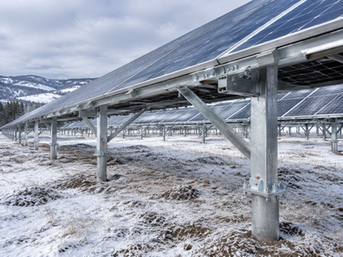
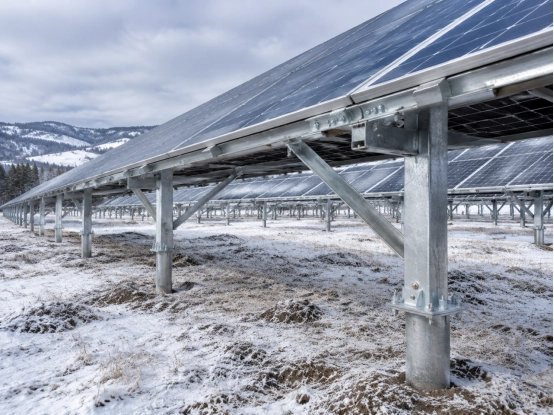
Ground-mounted PV stands on a lot of relatively short steel piles carrying a light structure. The frozen zone wraps right around the shafts, and adhered soil can pull upward on the steel — a force a summer check never sees.
Why does that hit solar harder than a house? A house rides on one deep, continuous footing. An array rides on many individual supports — ground moves unevenly under it, the piles move with it, and there’s no rigid base to hide the damage.
A foundation that behaves fine in summer can still face added uplift the moment the freeze arrives. That’s why we look closely at how soil conditions drive foundation embedment.
How Frost Heave Affects Ground-Mounted Solar Panel Foundations
Pile Uplift and Foundation Displacement
What does frozen ground do to the pile? It grips the surface and pulls the foundation up. One winter might cost you 5 mm of embedment. Four winters later that’s 20 mm of drift, and the embedment carrying the load has quietly shrunk. We’d want to catch it in the first winter, not the fourth.
Differential Heaving and Structural Misalignment
Heave isn’t even across a field. Which rows move first? The silty ones — one row heaves hard while the row across the track on gravelly soil barely moves. Row elevation and alignment drift with it, and a straight array ends up stepped or tilted, with modules off their design positions.
Increased Stress on Mounting Components
Movement at the pile travels up into the structure. Where does it show up? In the rack: torque tubes, rails, and connections pick up stresses the design never intended. Bolts and clamps drift out of alignment, and left alone the movement can damage modules. Frost heave isn’t only a buried-foundation problem — it can affect the whole mounting system.
What Site Conditions Increase the Risk of Frost Heave?
Soil Composition
Wary of one soil type? Silty sands — the fine particles hold water and form ice lenses readily. Gravel and coarse sand hold far less water — the risk drops with it.
Groundwater and Drainage
What feeds the ice lenses? Moisture — a high water table, and poor drainage parking water right by the piles. Either one is worth flagging in the geotechnical report.
Climate and Frost Depth
What pushes frost deeper? Long freezing periods and low temperatures. Say the local frost depth is 1.2 m: anchor at 1.0 m and the anchor sits inside the active zone. Embedment should follow the local frost depth, not a figure borrowed from a warmer region.
Solar Array Ground Conditions
Under the array the ground isn’t what you’d expect. Modules change how snow settles and how well the soil insulates, so freezing beneath a row of panels runs differently from open ground. Measure the ground temperature there; don’t assume it.
How to Reduce Frost Heave Risks in Solar Foundation Design
Conduct a Geotechnical Site Investigation
Start in the ground, not on the drawing. Ask the investigation for soil composition, moisture content, and groundwater level, plus the local frost depth and where the frost-susceptible layers sit. That report drives the foundation choice and depth.
Increase Foundation Embedment Depth
How deep is deep enough? Below the active frost zone, where stable soil gives real anchoring resistance. The uplift resistance has to beat the calculated frost-induced forces. Depth alone won’t kill frost jacking, though — soil above can still grip the shaft and pass force up it.
Use Anti-Adfreeze Measures
Here the goal is simple: stop the frozen soil gripping the pile. Smooth surfaces or purpose-built sleeves cut the adhesion. Bond-breaker material caps how much force transfers upward. And where the design allows, a gravel sleeve or clean granular backfill keeps the pile and the heaving ground from acting as one unit.
Improve Soil Drainage
What fuels heave? Water. Give the site a way to shed it: surface drainage so nothing pools near the piles, and — where the engineering calls for it — non-frost-susceptible granular material in place of the fine soil that would heave.
Select the Right Foundation Type
Match the foundation to the soil and the frost, not to habit. A ground screw pile works well when its helix anchors below the active frost zone and the uplift resistance checks out. No single type suits every cold-climate project.
What Should Be Checked Before and After Solar Foundation Installation?
Before Installation
Review the geotechnical report. Confirm the foundation dimensions and the specified embedment depth. Run solar pile load testing — pull-out, lateral, and compression, as the design requires. One thing we’re firm on: a routine pull-out test doesn’t replace a frost heave analysis — that needs its own assessment.
After Installation
Once the array is up, we watch it through a winter. Check pile elevations and structural alignment after the cold season. Inspect foundation displacement, connection bolts, and mounting components. Flag the rows that move more than expected so corrective maintenance can target them.
How to Choose the Right Solar Mounting Foundation for Cold Climates
Which factor comes first? Soil compatibility — the foundation type has to fit the local geotechnical conditions. Then structural strength: can it resist uplift, compression, and lateral forces? Material durability is a separate question: galvanized or Zn-Al-Mg coated steel earns its place through corrosion protection, not heave resistance. Finally: can the mounting structure and connection parts be matched to the project’s own drawings?
How CZT Solar Supports Ground-Mounted PV Projects
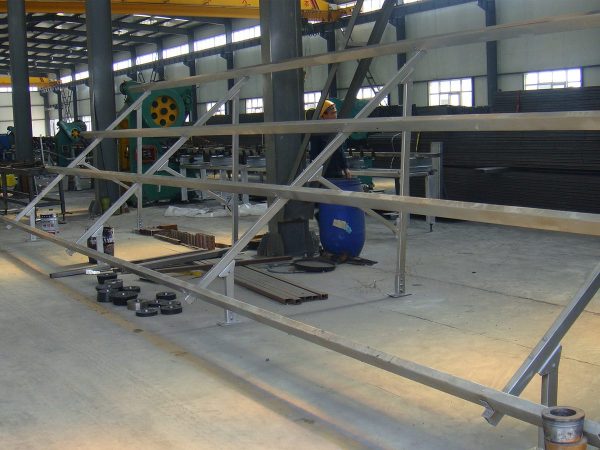
CZT Solar is a one-stop photovoltaic mounting system provider. Foundation options run from C-type pile foundations et H-type pile foundations to concrete foundations and ground screw pile systems, in galvanized or Zn-Al-Mg coated steel. The mounting structure and its connection parts are built to fit the site; if the soil conditions or specifications are particular, we walk them through so the foundation fits the ground.
A geotechnical investigation, a foundation matched to the soil and the frost, and a structure built to carry the movement keep cold-climate arrays stable. If your site’s conditions are uncertain, bring them to CZT Solar and we’ll work through the right foundation together.
Frequently Asked Questions
Can Frost Heave Lift Solar Foundation Piles?
Yes, it can. Frozen soil grips the pile surface and generates an upward force that can displace the foundation — especially in frost-susceptible soil with a high water table.
Does Installing Solar Piles Below the Frost Line Prevent Frost Heave?
Not by itself. Soil above the frost line can still adhere to the shaft and pull it up. Sufficient embedment needs the right anti-adfreeze and drainage measures alongside it.
Are Ground Screws Suitable for Cold-Climate Solar Projects?
They can be. The helix has to anchor below the active frost zone, and the design has to carry the frost-induced forces for the site.





 French
 English
 Japanese
 Korean
 Spanish
 Arabic
 Russian
 Thai