

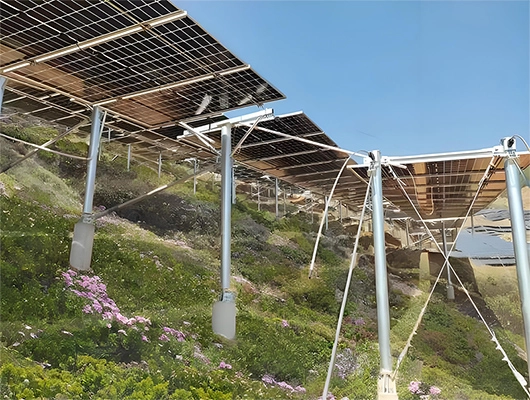
Real solar sites are rarely flat. Rolling farmland, mountain slopes, reclaimed land, and sites with several meters of elevation change are common.
On these sites, the wrong mounting structure pushes costs into grading, pile adjustment, and extra labor. A suitable solar mounting structure for sloped and uneven terrain should tolerate reasonable ground variation without compromising structural safety.
What Challenges Does Sloped and Uneven Terrain Create for Solar Projects?
Uneven terrain affects foundations, alignment, drainage, and construction progress at the same time.
Elevation Differences
Elevation changes directly affect post height and beam position. On gentle terrain, several standard post lengths may be enough. On irregular sites, adjustable connections become more important.
Forcing one rigid structure onto changing land often transfers cost from steel to earthwork. Controlled variation in post lengths is usually more practical.
Irregular Slopes
A drawing may show an average slope of 8° or 10°, but the ground rarely stays that consistent. Local ridges and cross-slopes appear between rows.
If adjustment is insufficient, crews start adding shims, drilling holes, or modifying steel on site. The structure should absorb normal terrain variation before installation reaches that point.
Foundation Conditions
Slope does not tell the full story. Soil does.
Driven piles may work well on one hillside and poorly on another with shallow rock. Ground screws suit some mixed soils. Concrete remains practical where piling is difficult.
Topographic and geotechnical data should be reviewed together.
Drainage and Erosion
Heavy grading can change natural water paths.
After strong rain, runoff may concentrate around pile rows or erode exposed soil. Preserving existing drainage patterns is often better than creating a perfectly level platform.
Key Factors to Consider When Choosing a Solar Mounting Structure
The mounting system should follow actual site constraints, not a standard product drawing.
1. Terrain Slope and Elevation Variation
Start with the topographic survey.
Average slope matters, but elevation differences between adjacent tables are often more important. They determine how much post-height variation and connection adjustment the structure needs.
On rolling farmland, repeated 300–500 mm changes across short distances may matter more than the overall slope. Enough vertical adjustment can avoid extensive cut-and-fill work.
Very abrupt changes are different. Shortening table length or splitting an array may be cleaner.
2. Soil and Foundation Conditions
Foundation type affects structural performance and installation speed.
Driven piles are efficient where soil resistance and driving conditions are suitable. Ground screws can offer flexibility in some soils. Concrete may be required where pile installation is impractical.
Rock depth deserves attention. Trial piles and pull-out tests can prevent expensive changes after production starts.
3. Wind and Snow Loads
Sloped terrain can change wind exposure. Rows near ridges or open edges may see different loading from rows lower on the site.
Post spacing, beam size, bracing, foundation depth, and connection strength should be checked against project-specific wind and snow data.
Adding heavier steel everywhere is rarely the best solution. Structural optimization is usually more economical.
4. Module Layout and Tilt Angle
Terrain adaptation should not create random module angles.
The structure still needs to maintain tilt, row spacing, and shading limits. Shorter tables follow changing ground more easily, though they increase connection count.
The right balance depends on layout efficiency and site conditions.
5. Installation Efficiency
A structure can look efficient in calculations and still be difficult to build.
Adjustment points should be accessible. Components should be easy to identify when several post lengths are used. Fastener types should be limited where possible.
Pre-assembled and properly fabricated parts help. So does avoiding field drilling. On a large solar farm, saving a few minutes per table matters.
Best Solar Mounting Solutions for Sloped and Uneven Terrain
Several structural approaches can work. The choice depends on terrain variation and how much civil work the project wants to avoid.
Adjustable Ground-Mounted Solar Structures
Adjustable ground-mounted structures are often suitable for moderate slopes and rolling terrain.
Variable post heights and adjustable beam connections let the upper structure maintain module position while foundations follow the ground.
The adjustment range needs to be realistic. Too little creates field modification; too much can make installation control harder.
Terrain-Following Solar Mounting Systems
Terrain-following systems follow natural contours rather than maintain one fixed elevation across long rows.
They can reduce grading, preserve drainage, and lower civil work. On large projects, modest excavation per row quickly becomes a large soil volume.
Benefits:
- Lower civil engineering requirements
- Faster construction
- Less environmental disturbance
Some local slopes are still better handled by changing the layout.
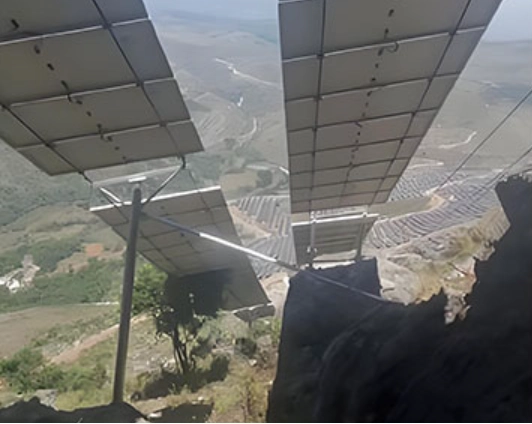
Flexible Solar Mounting Systems
Flexible solar mounting systems can suit some mountainous, agricultural, or irregular sites where conventional structures would require many foundations.
Long spans may help cross difficult ground.
These systems need careful checking for wind response, anchoring, cable behavior, and long-term deformation. They are not automatically the best choice for every slope.
Should You Level the Land Before Installing Solar Mounting Structures?
Not always.
Minor grading is normal for roads, drainage, equipment access, or isolated high points. Flattening an entire sloped site adds excavation, transport, compaction, and sometimes retaining work.
Where terrain variation is moderate, adapting the mounting system is often more economical than adapting the whole site to the structure.
The target is not zero earthwork. It is avoiding unnecessary earthwork.
How Customized Solar Mounting Structures Can Reduce Project Costs
Customization does not mean making every component unique.
A good design groups post lengths into practical ranges, optimizes beam sections, provides adjustment at key connections, and matches foundations to actual site data.
This can reduce steel waste, field modification, grading, and installation delays. On uneven terrain, a more adaptable structure may cost slightly more per unit yet lower total installed cost.
CZT Solar develops customized solar mounting structures based on layout, terrain data, environmental loads, foundation conditions, and installation needs.
What Information Should You Provide to a Solar Mounting Supplier?
A useful quotation needs more than project capacity.
Provide the project location, module dimensions, layout, tilt angle, topographic survey, maximum slope, wind speed, snow load, and available geotechnical information.
If the EPC prefers driven piles, ground screws, or another foundation type, include that. Coastal or high-humidity projects should also state corrosion requirements.
Better input data means fewer assumptions in the design.
Conclusion — Choose a Mounting System That Adapts to the Site
Sloped ground is not automatically a difficult solar site. The real issue is whether the mounting structure matches the terrain.
Useful questions are practical: how much elevation changes between tables, what foundation can actually be installed, how much grading can be avoided, and how much adjustment crews need.
CZT Solar provides customized solar mounting solutions for sloped, uneven, and complex terrain, including ground-mounted and flexible mounting structures. Project layouts, terrain data, wind and snow loads, and soil information can be reviewed to develop a system suited to actual site conditions.
Contact our engineering team with your project layout, terrain data, wind load, and soil information to receive a customized mounting solution.
자주 묻는 질문
Q: Can solar panels be installed on uneven ground?
Yes. Ground-mounted solar systems can be installed on uneven terrain when the structure provides suitable post-height and connection adjustment.
Q: What is the best solar mounting system for sloped land?
Adjustable ground-mounted structures are often practical for moderate slopes. Terrain-following or flexible systems may suit more irregular sites. Soil, wind load, table length, and construction method should decide the final choice.
Q: Do solar farms need perfectly level ground?
No. Selective grading may still be needed, but complete leveling is often unnecessary. A terrain-adaptive mounting structure can reduce earthwork.
Q: Are driven piles suitable for sloped terrain?
They can be. Suitability depends on soil resistance, rock depth, lateral load, pull-out capacity, and installation access rather than slope alone.
Q: How can earthwork costs be reduced on an uneven solar site?
Use accurate topographic data early, adjust row layouts to terrain, select the right foundation, and allow practical height adjustment in the mounting structure.







 Korean
  English
  Japanese
  Spanish
  Arabic
  Russian
  French
  Thai
Thai