

A ground-mounted solar array is only as reliable as the structure beneath it. Modules and rails receive most of the attention, but foundation problems are usually harder to correct once installation begins.
Ground screws and concrete foundations can both support solar mounting systems. Their behavior on site, however, is quite different. Installation speed, soil conditions, equipment access, corrosion risk and eventual decommissioning all affect the decision. The cheaper-looking option on a drawing may not be the cheaper option after construction starts.
What Are Ground Screw and Concrete Foundations?
Both systems transfer compression, uplift and lateral loads from the solar mounting structure into the ground. They simply use different mechanisms to achieve that transfer.
What Is a Ground Screw Foundation?
A ground screw is a steel foundation element with one or more helical blades. It is installed by rotating it into the soil with hydraulic equipment. The mounting post or structural frame is then connected to the head of the screw.
There is usually no large excavation, no formwork and no concrete curing period. On a suitable site, a crew can install the screw and begin mounting work soon afterward.
What Is a Concrete Foundation?
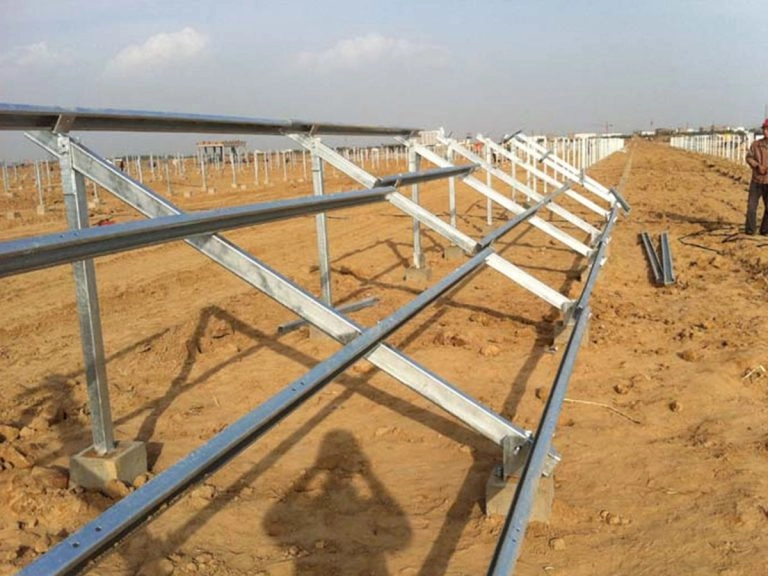
Concrete foundations for solar projects may be cast-in-place piers, spread footings, reinforced blocks or precast units. The selected form depends on structural loads, soil bearing capacity and local construction practice.
A typical cast-in-place foundation requires excavation or drilling, reinforcement placement, concrete pouring and curing. The process is familiar and flexible. Dimensions can be adjusted to suit unusual loads or poor soil near the surface.
Concrete also adds mass. That can be useful where resistance to overturning is a major concern, although increasing foundation size also increases excavation, transport and labor.
How Do Ground Screws and Concrete Foundations Compare?
The practical differences become obvious once equipment and crews arrive on site.
| Comparison Factor | Ground Screws | Concrete Foundations |
| Installation speed | Installed and loaded quickly | Requires excavation, pouring and curing |
| Site disturbance | Limited soil removal | More excavation and spoil handling |
| Terrain response | Works well on many slopes and uneven areas | May require grading or stepped foundations |
| Weather sensitivity | Less affected by curing conditions | Pouring and curing can be weather-sensitive |
| Removal | Usually removable with mechanical equipment | Demolition and waste disposal are often required |
| Main constraint | Difficult installation in rock or obstructed soil | Longer construction sequence and greater site impact |
This table is useful for screening options, not approving one. A foundation decision still needs geotechnical data and structural calculations.
Which Foundation Is Better for Different Soil and Terrain Conditions?
Soil is usually the deciding factor. Project size matters, but a large solar farm on suitable soil may be easier to support than a small array on uncontrolled fill.
When Are Ground Screws More Suitable?
Ground screws perform well in many compact soils where the shaft and helical plates can develop adequate compression and pull-out resistance.
They are especially attractive on sloped land. Instead of cutting the entire site to one level, installers can adjust screw elevations and follow the terrain. This reduces grading and helps preserve drainage patterns.
A common example is an agricultural solar project on leased land. The owner wants limited disturbance and expects the site to return to farming after the project. Removable steel foundations make sense there.
When Are Concrete Foundations More Suitable?
Rocky ground can stop a ground screw almost immediately. Buried boulders create the same problem, often less predictably. Pre-drilling may help, but repeated obstruction can remove the speed and cost advantage.
Concrete foundations are also useful where loads are high and the engineer needs a wide bearing area or a heavily reinforced connection. Some local authorities and contractors simply have more experience with concrete. That familiarity can reduce approval and execution risk.
Soft upper soil does not always mean concrete is better. A shallow concrete footing may still settle. The design must reach competent material or distribute the load properly.
Which Option Offers Faster and More Efficient Installation?
Ground screws are generally faster when the soil is suitable and installation equipment can move freely. One machine can install a large number of foundations without waiting for concrete trucks, testing samples or curing periods.
Efficiency can change within a few meters. A crew may install ten screws smoothly, then encounter a buried rock band and lose an hour on the next position. Trial installations should happen before the full production schedule is fixed.
Concrete work moves more slowly, but it can be predictable when local labor and ready-mix supply are reliable. On remote sites, that predictability often disappears. Long haul distances, limited water and hot weather complicate the pour.
Which Foundation Is More Cost-Effective Over the Project Lifecycle?
Foundation cost should include more than steel or concrete quantities.
Ground screws may reduce excavation, spoil removal, grading and waiting time. They can also reduce decommissioning costs because the steel elements can usually be extracted and recycled.
The installation equipment is specialized, though. Rocky ground may require pre-drilling, stronger screw profiles or abandoned positions. Each adjustment adds cost.
Concrete appears inexpensive when only material prices are compared. The full cost includes drilling, reinforcement, formwork, transport, quality control, curing protection and eventual demolition. On an accessible site with abundant local materials, it may still be the economical choice.
A lifecycle estimate is more useful than a foundation unit price.
How Do Durability and Structural Performance Compare?
Both systems can provide long service life when correctly designed.
For ground screws, corrosion protection deserves close attention. Galvanizing thickness, soil resistivity, moisture, pH and chloride content affect durability. Coastal soil and chemically aggressive fill should not be treated as normal conditions.
Installation quality is equally important. Screw depth, torque records and pull-out testing provide evidence that the foundation matches the design assumptions.
Concrete foundations face different problems: cracking, poor consolidation, reinforcement exposure, frost damage and uneven settlement. Water collecting around the foundation can shorten service life, particularly in freeze-thaw climates.
The mounting structure and foundation should be checked as one load path. A strong foundation does not correct a weak post connection.
Which Foundation Has a Lower Environmental Impact?
Ground screws usually cause less immediate disturbance. They require limited excavation and avoid large volumes of concrete. Vegetation can often remain between foundation points.
Removal is also cleaner. The screws can be rotated out, leaving relatively small holes that can be backfilled.
Concrete has a larger permanent footprint. Demolition produces waste, and buried sections are sometimes left in place because removal is difficult. Still, environmental performance depends on the whole project. Locally supplied concrete may create less transport impact than steel foundations shipped over a very long distance.
How Should You Choose the Right Foundation for Your Solar Project?
The decision should start with site investigation, not a product catalogue.
Check the soil profile, groundwater, corrosion potential, frost depth and presence of rock. Confirm compression, uplift and lateral loads for the mounting system. Review access for installation machinery and material delivery.
A practical selection checklist:
- Geotechnical investigation results.
- Trial installation or pull-out test data.
- Wind, snow and seismic requirements.
- Terrain slope and grading limits.
- Equipment and material availability.
- Total installed and lifecycle cost.
Ground screws are often the better engineering choice for fast construction, limited disturbance and future removal. Concrete remains sensible for obstructed ground, unusual load conditions or projects where local construction resources strongly favor it.
Build Your Solar Project on the Right Foundation
Foundation selection should happen early, while the mounting layout can still be adjusted. Waiting until procurement often leads to compromises—wrong pile spacing, unnecessary steel or expensive site corrections.
CZT Solar provides ground-mounted solar structures and customized metal components for different project conditions. Foundation interfaces, post dimensions and connection details can be developed around actual soil data rather than forced into a standard arrangement.
Contact CZT Solar to discuss the foundation conditions, structural requirements and customized mounting solution for your next solar project.
FAQ
Q: Are ground screws suitable for all types of soil?
No. They work in many soil conditions but may be difficult to install in shallow rock, dense gravel, buried construction debris or ground with large boulders.
Q: Do ground screws need concrete around them?
Normally, no. The screw transfers load directly into the surrounding soil. Concrete may be added in special designs, but doing so removes some of the speed and removability advantages.
Q: How long must concrete foundations cure before installing the solar structure?
The required period depends on the concrete mix, temperature, design strength and engineer’s instructions. Mounting work should not begin simply because the surface appears hard.
Q: Can ground screws support utility-scale solar projects?
Yes. Ground screws can be used for large solar arrays when load capacity, corrosion protection and installation quality are properly verified.
Q: Which foundation is better for a temporary solar installation?
Ground screws are usually preferred because they can be installed with limited disturbance and removed at the end of the project. The soil must still be suitable for the required structural loads.





 French
  English
  Japanese
  Korean
  Spanish
  Arabic
  Russian
  Thai
Thai