

Landscape looks like the obvious way to make a ground-mounted array lower. Turn a tall rectangle on its side and it becomes shorter. Fair enough. But how many of those rectangles will you stack up the slope? For a fixed-tilt project, we’d choose between portrait and landscape only after drawing the whole table and checking where the modules can be fixed.
Portrait puts the module’s long edge up the slope. Landscape turns it across the table. Neither choice tells you which compass direction the array faces.
Keep the module count equal when comparing portrait vs landscape solar panels. Otherwise, you may be comparing a small array with a large one and crediting the difference to orientation.
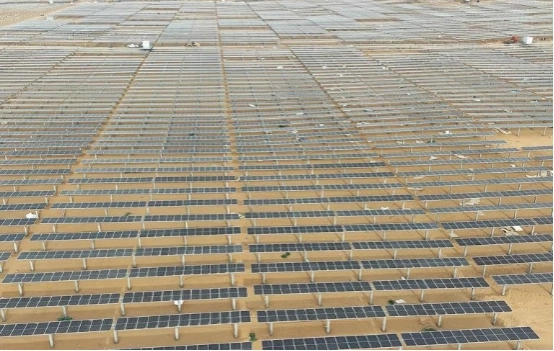
Does Landscape Mounting Really Use Less Land?
Let’s put twenty modules on a table. For this example, each measures 2,280 by 1,130 mm, and the gaps are 20 mm. The portrait drawing has ten across and two up the slope. On the landscape drawing, there are five across and four up the slope. Still twenty modules.
Here is what happens before you add any projecting steel:
| Dimension | Two-High Portrait | Four-High Landscape |
| Module count | 20 | 20 |
| Width along the row | 11.48 m | 11.48 m |
| Depth measured up the tilted surface | 4.58 m | 4.58 m |
| Vertical rise at a 25° tilt | 1.94 m | 1.94 m |
You can check the depth on a calculator: two lengths of 2.280 m plus one gap make 4.580 m. Across the other drawing, four widths of 1.130 m plus three gaps also make 4.580 m. At 25°, the upper edge sits about 1.94 m above the lower one in either drawing: 4.580 × sin(25°).
Same outline. Same rise. The extra gaps happen to cancel the difference in this example. Other module dimensions will give different results, but rotating the panels is clearly no guarantee of a shallower table.
For fixed-tilt ground mounting, draw the alternatives inside the actual site boundary. Perhaps one arrangement leaves room for a complete bay beside the turning area. That is a reason to prefer it. Just don’t lower its tilt or move its bottom edge closer to the ground halfway through the comparison.
Can the Same Clamps Work in Both Panel Orientations?
Possibly, although we’d leave that decision open until checking both the module drawing and the steelwork. They answer different questions.
Read the Module Mounting Drawing
Find the approved clamping zones for the exact module model. Look closely at the load table beside the drawing. Does it cover the frame side you intend to use? If you can only find a long-side fixing arrangement, you still need an answer about the short side.
Turn the module on your drawing, then leave the rails where they were for a moment. Where do they meet the frame now? If there is no approved fixing detail for that edge, try moving the rails. The holes lining up isn’t enough to settle it.
Match the solar panel clamps to that approved arrangement. Being able to fasten one onto the frame is only part of the job.
Follow the Supports under the Modules
Draw each support line through the whole table. Rotation can change the number of support lines you need and where their joints fall. That is where an apparent saving in steel can disappear.
Check the purlin connections at those joints, including room to fit and tighten the bolts. A slot gives some adjustment. It does not give you permission to shift the support outside the module’s allowed mounting zone.
Will Landscape Panels Lose Less Power to Shade?
Don’t award landscape the win on a shading sketch alone. Get the cell layout for the module you’re using, including its connections to the bypass diodes. Without that, the drawing tells you where the shadow falls but leaves the electrical question open.
Say the previous row throws a narrow shadow along the bottom of your table on a winter morning. In the rotated layout, which groups of cells would it touch? That is the comparison to make. Measuring the dark strip alone won’t tell you how much power is lost.
If better winter production is the reason for the change, we’d want to see the monthly energy figures for both arrangements. It’s hard to judge a winter benefit from one number covering the entire year.
What Changes for the Installation Crew?
Try a representative bay before repeating it across the site. Use the planned table height and the actual module size. An empty frame is a poor test of reach.
Imagine the lower modules are already secured. The crew now has to reach an inner clamp, with the next panel waiting beside the table. Can someone position the tool properly? Does the installation sequence leave the joint accessible? A few minutes spent there can settle an argument that a tidy drawing cannot.
Check cable reach with the modules in their final orientation, too. Leads that met comfortably in one arrangement may need a different route after rotation. Record the extra connections and handling steps in each trial. We’d trust that comparison more than a blanket claim that landscape installs faster.
Which Ground-Mount Layout Should You Take Forward?
Keep the arrangement that fits the site and works with the module’s approved fixing details. Then compare what the crew actually has to build. Still a close decision? Count the materials for both and put the energy estimates beside them. You may find there is little reason to change the original plan.
If you’re working through that choice, send us the two layouts. Add the module mounting instructions and mark the available ground dimensions. We’d also want to see the awkward corner or access route that started the discussion, even if the rest of the field looks straightforward.
FAQ
Does Portrait Mean the Panel Stands Vertically?
No, and this can cause confusion on a drawing. “Portrait” tells you which way the long edge runs. You could tilt either arrangement at 25°. To stand the modules vertically, you’d need a 90° tilt regardless of which edge is on top.
Can You Mix Portrait and Landscape on One Site?
You can. A difficult boundary might be a good reason to do it, after checking the supports and electrical layout for that section. Give the crew a separate detail for those tables. They shouldn’t have to guess where the usual arrangement stops.
Does Rotating a Module Change Its Rated Wattage?
No; you’re still holding the same module with the same rating. What may change is the electricity you get from it at that location. Work out any gain or loss from the revised layout and shading in the energy model.
Is Landscape Always Better in Strong Wind?
No. Compare the full table geometry and its supports under the site’s wind conditions. In the worked example, both layouts have the same outer dimensions. The word “landscape” alone tells you very little about the strength of either structure.





 English
 Japanese
 Korean
 Spanish
 Arabic
 Russian
 French
 Thai