

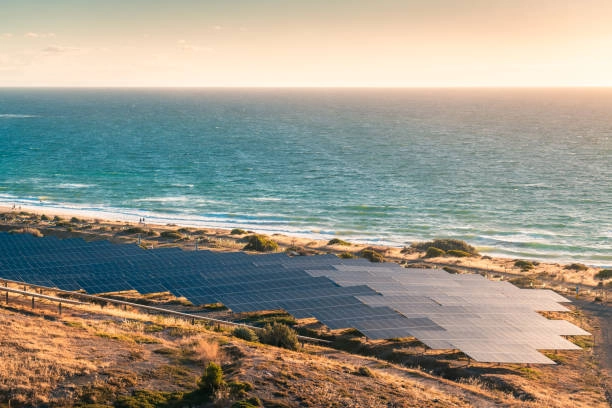
Engineering Challenges in Coastal Environments
Building a solar project within five miles of the ocean is a different beast entirely compared to an inland installation. The atmosphere is essentially a dilute acid bath mixed with a sandblaster. Standard engineering assumptions often fall short when faced with the relentless chemistry of the shoreline.
Why Coastal Projects Demand Specialized Mounting Solutions
- High salt spray concentrations accelerate electrochemical corrosion on standard metals.
- Constant exposure to humidity and UV radiation degrades traditional protective coatings.
- Coastal wind loads are often significantly higher and more turbulent than inland sites.
- Proximity to the shoreline dictates the severity of the atmospheric corrosivity category (C4 or C5).
When salt particles settle on a metal surface, they attract moisture, forming a highly conductive electrolyte that triggers rapid oxidation. Standard hot dip galvanizing is a decent baseline, but in a C5 environment, the zinc sacrificial layer can vanish at an alarming rate. You also have to worry about the mechanical side; coastal winds aren’t just strong, they are gusty and come from shifting directions, putting immense fatigue stress on every bolt and rail.
Materials That Stand Up to Salt and Wind
The selection of raw materials determines whether a solar mounting system lasts its intended 25 year lifespan or requires a full structural replacement in year seven. We are seeing a major shift away from simple carbon steel toward more sophisticated alloys and coatings.
The Shift Toward Zinc-Magnesium-Aluminum (ZMA) Coatings
- ZMA coatings offer self healing properties on cut edges, vital for long term coastal integrity.
- Superior scratch resistance compared to traditional pre-galvanized steel.
- Extended lifespan in high chloride environments without the weight of heavy galvanization.
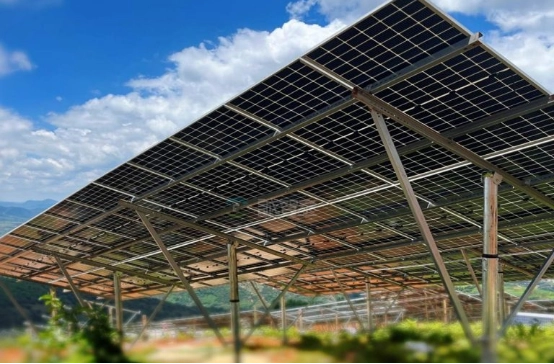
In our experience, the “self healing” aspect of ZMA is the real game changer. When you cut a rail or drill a hole on site, the magnesium in the coating reacts to form a dense protective film over the exposed steel. It’s a massive relief for installers who can’t always paint every single nick. Many modern systems, like the Zn-Al-Mg steel ground mounting structure, leverage this chemistry to provide a 25 years service life even in harsh zones.
When is Anodized Aluminum the Right Choice?
- Lightweight properties reduce the structural load on coastal rooftops.
- Natural oxide layers provide an inherent defense against salt induced pitting.
- Aesthetic considerations for residential or commercial coastal developments.
Aluminum is often the go-to for roof mounted projects. For instance, solar panel clamps are frequently made of Al6063-T5 because it handles the salt air without the bulk. However, for large ground mounts, steel remains king for its sheer stiffness.
Structural Integrity Against High Velocity Winds
Coastal regions are notorious for “micro-climates” where wind speeds can exceed 200km/h. A standard rail might hold, but the vibration—the fluttering—is what eventually snaps the fasteners.
- Dynamic wind load analysis ensures the mounting system can withstand localized coastal gusts.
- Importance of choosing high tensile fasteners to prevent mechanical failure during storms.
- Aerodynamic rail profiles minimize uplift forces on large scale solar arrays.
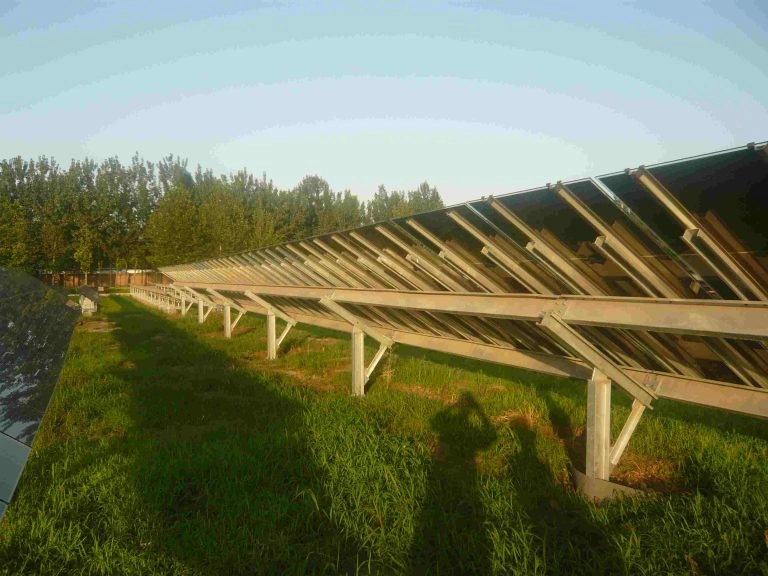
We often specify components like the H type pile foudation for solar ground mounting system because it offers 216km/h Wind load resistance. The H beam steel, also known as H shaped steel , is a structural steel member with an “H” shaped cross section. It is widely used in construction, bridges, industrial frameworks, and high rise buildings due to its high load bearing capacity, stability, and efficiency in weight distribution .
Critical Design Features for Longevity
It is not just about the big beams; the small details are where coastal projects fail. If you put an aluminum clamp directly on a galvanized steel rail without a barrier, you’ve just built a very expensive battery that will eat itself.
Eliminating Galvanic Corrosion in Multi-Material Systems
- Using specialized gaskets and washers to separate dissimilar metals.
- Preventing the “battery effect” that leads to rapid hardware failure in salty air.
Innovative Grounding and Bonding for Coastal Safety
- Salt buildup can impact electrical conductivity and grounding path reliability.
- Selection of corrosion resistant grounding lugs and clips for harsh environments.
Using unistrut channel steel can be helpful here as it is a high quality, slotted metal framing system designed for modular construction, electrical support, mechanical installations, and structural applications. Its pre-slotted design – allows for easy adjustment and fastening without drilling. This reduces the amount of raw metal exposed during the installation process.
Maintenance Strategies for Coastal Solar Assets
You cannot just “install and forget” a coastal array. Salt crusts are hygroscopic; they pull moisture from the air even on dry days, keeping the metal wet and corroding.
- Regular rinsing schedules to remove accumulated salt crusts from rails and brackets.
- Visual inspection protocols for identifying early signs of crevice corrosion.
- Torque auditing of fasteners after major wind events to ensure structural tension.
We’ve seen sites where a simple bi-annual freshwater wash extended the life of the steel channel components by a decade. It’s a low-tech solution to a high-tech problem.
Selecting the Appropriate System for Your Site
Every coastline has its own personality. Some have high dunes that shield the wind, others are flat and exposed. You need to match the hardware to the specific physics of your site.
How to Match Mounting Hardware to Local Wind Codes
- Understanding ASCE 7 or local equivalent requirements for coastal zones.
- Balancing initial capital expenditure with the total cost of ownership over 25 years.
- Partnering with manufacturers like CZT Solar for custom engineered metal structures tailored to specific wind maps.
For heavy duty support, a Z steel channel is often preferred because it is engineered for heavy duty support in construction and industrial settings. If the project involves complex geometries or high torsional requirements, the omega steel beam is an excellent choice as its optimized Ω-shape resists bending, buckling, and dynamic loads.
Working with a one stop service provider for the PV Mounting system like CZT solar ensures you get customized solutions for global customers that account for these specific environmental stressors.
FAQ
Q: What is the best material for solar mounting near the ocean?
Zinc-Magnesium-Aluminum (ZMA) coated steel and anodized aluminum are the top choices. ZMA is particularly effective for ground mounts due to its self healing properties on cut edges.
Q: How often should coastal solar racks be inspected?
At a minimum, every six months. You should check for salt buildup, signs of pitting, and fastener torque, especially after the stormy season.
Q: Can standard galvanized steel be used in coastal zones?
It is risky. Standard galvanization may only last a few years in a C5 corrosivity zone before the base steel begins to rust. High thickness hot dip galvanizing or ZMA is much safer.
Q: Does wind speed affect the choice of pile foundation?
Absolutely. For high wind coastal areas, we typically use an H Type Pile Foudation for solar ground mounting system or a C Type Pile Foudation for solar ground mounting systerm designed for Wind load: 50-60m/S.





 English
  Japanese
  Korean
  Spanish
  Arabic
  Russian
  French
  Thai
Thai