

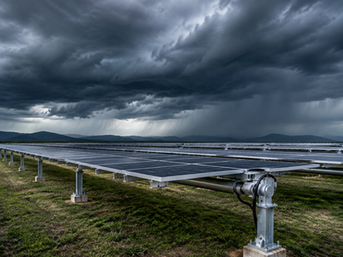
The storm arrives the same afternoon the grid goes down. Wind is building, and the rows are still at their mid-morning tracking angle — high on the torque tubes, wide in the gusts. That is the moment solar tracker stow systems exist for: backup power, intelligent controls, and mechanical protection holding together so no row stays caught where it was.
What Is a Solar Tracker Stow System?
A one-axis solar tracking system turns its rows through the day to follow the sun. Stow is a different mode: on command, or when conditions force the decision, the row moves to a predetermined safe position and holds.
That position is not universal. Tracker design sets it and the site’s wind adjusts it — one array stows flat, another at a shallow tilt, both can be right. The solar tracker components behind it: wind speed sensors, tracker controllers, drive motors and actuators, backup power supplies, and the mechanical support structure.
Why Are Power Failures a Serious Risk for Solar Trackers?
Severe weather is precisely when the grid is least reliable. A storm cell can trip feeders and reach the site minutes later, and if the system runs on outside power for its controllers and drive motors, a solar tracker power failure can leave rows mid-position as the wind rises.
Wind load on an open row lands on torque tubes, bearings, brackets, posts, and foundations, all sized for the stowed configuration. Where a project relies on active stow to meet its wind load case, the outage scenario belongs in the design file — regulators in some US states, Oregon among them, have made that demonstration formal. Solar tracker structural safety starts upstream, in how a mounting system for high-wind regions is chosen.
How Solar Tracker Stow Systems Handle Power Failures
Two families: rows that finish the move on their own power, and rows that need no power at all.
1. Battery-Backed Tracker Controllers
A battery-backed controller keeps the essential circuits alive when the main feed drops, powering the controller and sensors — and, depending on the design, the drive mechanism — long enough to run the emergency stow command. Capacity is the number that matters: a pack sized for a control ping cannot turn a row.
2. Uninterruptible Power Supply (UPS)
A UPS plays the same role, handing clean, temporary power to critical control and drive equipment the moment the main supply fails. Sizing is the design question: enough reserve to move the row all the way to stow. One row’s controller is a simple box; an array’s control room is not.
3. Self-Powered Solar Tracker Systems
Some tracker architectures carry a dedicated photovoltaic source plus local storage, cutting dependence on grid electricity. The test is what the bank holds after a week of cloudy mornings — enough to move every row it must protect?
4. Passive Mechanical Stow Protection
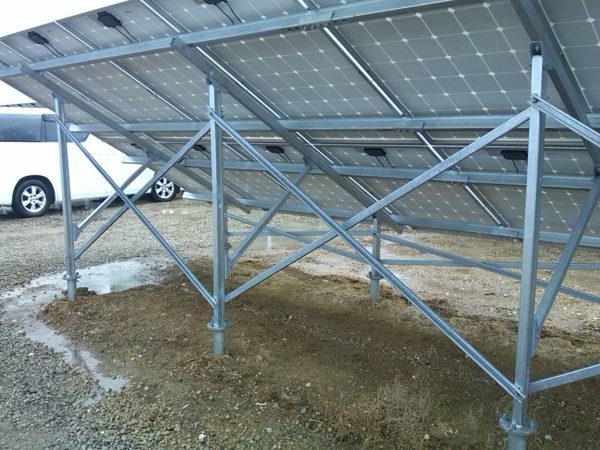
The other family skips the power question. A passive mechanical stow uses torque-limiting elements or a specialized clutch that answers the wind’s own force — load passes the design value and the row lets go to stow, no sensor, no controller, no battery. Sandia National Laboratories has compared that with active, sensor-controlled stow. It needs no outage-proof power chain; its results depend on the tracker architecture.
What Happens When a Solar Tracker Loses Power?
The sequence runs in order:
Power Interruption — the tracker detects a loss of its primary power supply.
Backup Activation — the battery or UPS supplies emergency electricity, where applicable.
Emergency Command — the controller initiates the predefined stow sequence.
Mechanical Movement — drive motors and actuators move the rows toward their safe positions.
Status Monitoring — the system checks operating status and flags a fault if the movement fails.
How far it runs unattended depends on the design — some rows finish on their own, others stop short and wait for a technician.
What If the Backup Power System Also Fails?
The list is short and familiar: a battery degraded past its capacity, a UPS with a failed connection, a communication path that drops between sensor and controller, a motor that seizes mid-move. Each leaves a row sitting up in the wind with nothing to move it.
Backup power alone does not guarantee safe stowing. The design has to coordinate electrical controls, mechanical components, and structural design, and the site has to run inspections and fault detection that do not assume a working grid.
What Should You Consider When Choosing a Solar Tracker Stow System?
A stow specification is a set of promises. Solar tracker reliability is decided against the site, not in the datasheet — check each promise in turn.
Key Factors to Evaluate
Backup Power Capacity — complete the emergency stow during a grid outage, or only start it?
Wind Protection Strategy — does the solar tracker wind stow suit the local wind, including its direction and gusting?
Control System Reliability — operate independently if central communication is interrupted?
Mechanical Durability — are drive components, connections, and supports built for the expected loads?
Maintenance Requirements — backup batteries, sensors, and electrical components easy to inspect over the plant’s life?
Structural Compatibility — does the solar tracker mounting system, foundations included, meet the project’s engineering requirements?
Where it comes down to architecture, the difference between one-axis and four-direction trackers often settles it.
Why Does Mounting Structure Quality Matter for Emergency Stow?
A stow command is only as good as the steel it lands on. The structure carries normal tracking loads and emergency wind loads alike — tube, post, bracket, fastener, and foundation each take a share — and material selection, corrosion protection, and precise fabrication decide how much margin is left after a decade outdoors.
Those numbers come out of the wind load calculations for the ground-mounted structure: stow angle, pressure on an open row, direction of the design gust. Get the math wrong and a row that stows on schedule is stowing into steel never sized for it.
How CZT Solar Supports Reliable Solar Mounting Projects
The electrical half of stow is only part of the job; the other half is the steel that has to hold. CZT Solar supplies solar tracking mounting systems for that role — one-axis solar trackers, four-direction tracking systems, and the mounting structures that go with them — plus steel channels, welding parts, and customized metal components.
The loads, stow angle, and site conditions get worked out against the actual structure before the first row ships — the job of customized solar mounting solutions from a PV mounting system manufacturer.
Frequently Asked Questions
Can Solar Trackers Operate During a Power Outage?
It depends on the tracker’s power architecture and whether backup energy is available. A row with a battery-backed controller or a UPS can still run a stow command after the grid drops; a passive mechanical stow does not wait for a command at all. A row with neither stays where it was.
Do All Solar Trackers Need a Battery Backup?
No. Battery-backed controllers and UPS units cover the active stow designs. Certain passive mechanical stow designs reach their safe position on wind force alone and need no external backup power.
Is a Flat Position Always the Safest Stow Angle?
Not automatically. Flat is the common default and suits many wind cases, but the right stow angle comes from the tracker design, the wind conditions, and the engineering analysis behind both — some arrays shed loads better at a shallow tilt.
Conclusion
A storm is no reason for a tracker to be caught unprepared. Backup power, controls, and the structure behind them must be designed as one system, not three. If your stow plan needs to be matched to the steel, contact CZT Solar for customized solar mounting solutions while the layout can still change.





 Japanese
 English
 Korean
 Spanish
 Arabic
 Russian
 French
 Thai