

A pipe support that works at a short span may bend too far when the supports move apart. That is why strut channel load capacity needs more than a quick check of steel thickness. Cable trays, industrial frames and solar arrays all put different demands on the same basic profile. Slotted strut channel makes alignment easier; solid strut channel keeps the web uninterrupted. Choosing between them starts with the load, the span and the connections.
1. What Is a Strut Channel? Understanding Its Basic Structure
Strut Channel Design and Components
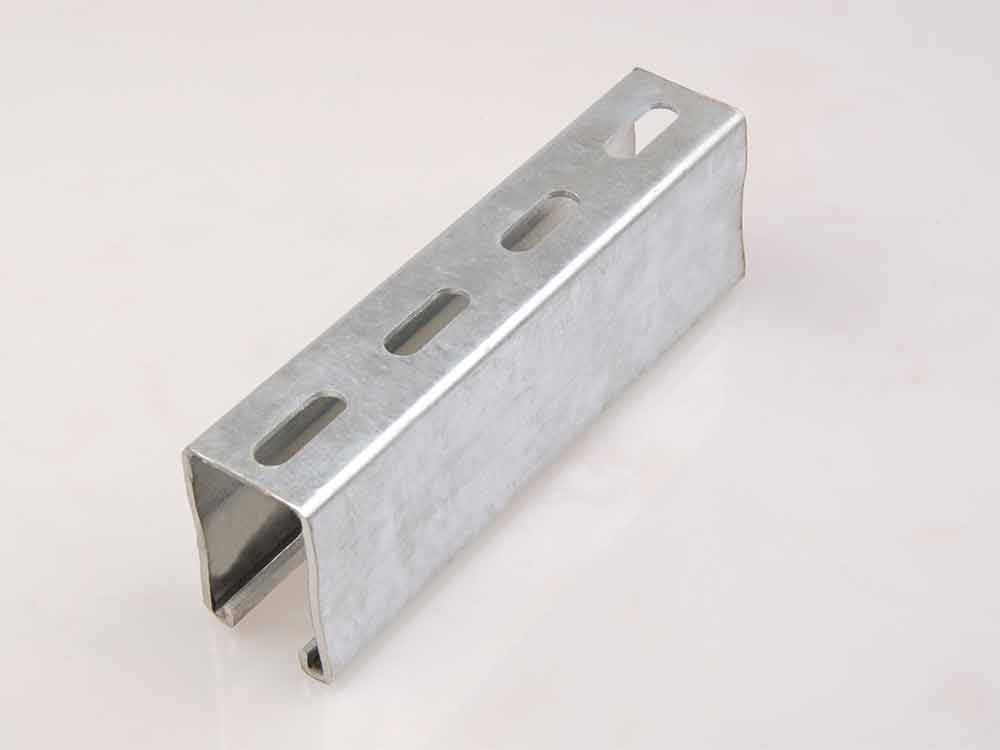
Cold-formed steel strut has a back wall, called the web, two flanges and inward-facing lips. The lips retain compatible channel nuts for attaching brackets.
Common Types of Strut Channels
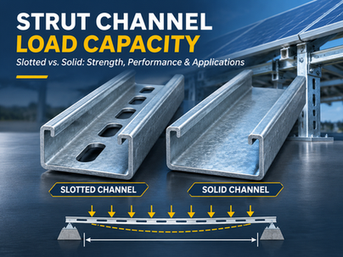
Solid means an unpunched web, not a solid steel bar. Slotted versions have factory-made openings. When selecting strut channel steel, check profile depth, hole shape and spacing; similar-looking sections are not necessarily interchangeable.
2. What Determines Strut Channel Load Capacity?
Steel Thickness and Material Grade
Thicker steel generally improves section properties. Steel grade affects strength, but higher yield strength alone does not stop a channel from deflecting.
Channel Dimensions and Cross-Section
Depth, width, lips and flange dimensions all matter. A deeper section can resist bending more effectively in the appropriate orientation.
Span Length and Support Conditions
Measure the distance between supports. Increasing that distance usually reduces the allowable load. A cantilever needs a different check from a beam supported at both ends.
Load Type and Distribution
A cable tray may spread its weight along the channel. A pipe clamp applies a concentrated load. Equal total weights can produce different bending demands.
3. How Do Slotted Sections Affect Strut Channel Load Capacity?
Impact of Pre-Punched Slots on Structural Strength
Slots remove steel and interrupt the web. Their edges can concentrate stress, while openings may affect shear resistance and local stability. The size of that effect depends on the actual section.
Load Distribution Around Slotted Areas
Forces pass through the steel remaining around each opening. Hole length, spacing and position relative to supports and bolts therefore need attention. Do not apply one universal percentage reduction to every slotted profile.
Connection Flexibility and Installation Advantages
Slots give bolts room for adjustment and reduce drilling during assembly. That helps when brackets need alignment on site. Check bolt bearing, washers and connection resistance as well as the channel itself; an acceptable beam rating does not validate every fixing arrangement.
4. Slotted vs. Solid Strut Channel: Which Has Higher Load Capacity?
Load-Bearing Performance of Solid Strut Channels
For matching dimensions, thickness and grade, an unpunched web provides a more continuous net section. This can help where holes would govern resistance.
Load-Bearing Performance of Slotted Strut Channels
A slotted section can still meet the design load. Use its specific rating and check the openings near loaded connections. Solid strut channel load capacity is not automatically higher in every comparison.
Key Differences Between the Two Types
|
Comparison |
Slotted Channel |
Solid Channel |
|---|---|---|
|
Pre-punched holes |
Yes |
No |
|
Installation flexibility |
Slot adjustment |
Some connections need drilling |
|
Net-section continuity |
Interrupted at slots |
More continuous |
|
Load performance |
Profile-dependent |
Profile-dependent |
|
Typical applications |
Adjustable supports |
Supports requiring continuous webs |
5. How to Calculate and Evaluate Strut Channel Load Capacity
Understanding Strut Channel Load Tables
Match the table to the exact profile, material, orientation and supports. Allowable load includes stated design assumptions; an unspecified “maximum load” may mean something else. Check whether figures represent total load or load per unit length.
Uniform Load vs. Point Load
For a simply supported beam, a central point load produces twice the maximum bending moment of the same total weight distributed uniformly. Do not use a uniform-load rating directly for a central hanger.
The Importance of Span Length and Deflection Limits
Strut channel load tables may include Span/180 or Span/240 limits. At a 1,200 mm span, these correspond to about 6.7 mm and 5 mm of deflection. Use the project requirement, then check strength, stability and connections separately.
6. How to Choose Between Slotted and Solid Strut Channels
When to Choose Slotted Strut Channels
Choose slots where installers need adjustment, modular assembly or changing attachment positions. Match solar mounting accessories to the channel and fastening arrangement before ordering.
When to Choose Solid Strut Channels
Choose a solid web where continuity is required or holes must follow a specific drawing. Some fittings attach through the open face without drilling. Any added holes need assessment. Compare installed cost, exposure and verified performance alongside purchase price.
7. How Manufacturing Quality Affects Strut Channel Performance
Precision Roll Forming and Punching
Consistent forming keeps the web, flanges and lips within specified tolerances. Accurate punching helps bolts fit without forcing parts together or enlarging holes on site.
Material Selection and Quality Control
Specify steel grade and thickness separately from the finish. Galvanized carbon steel and stainless steel suit different exposure conditions. Verify dimensions, material records and corrosion protection before accepting a batch.
Custom Strut Channel Manufacturing
For custom metal fabrication, provide drawings with section dimensions, slot spacing, cut lengths and finish requirements. Include connection details and design loads so the finished parts match the engineering assumptions.
8. Applications of Strut Channels in Solar Mounting Systems
Within systèmes de montage solaire, strut can support modules, brackets and auxiliary equipment when designed for those duties. Slots help align connections during installation. Outdoor design must address wind uplift, snow, corrosion and load transfer through the anchors. Panel weight alone is not enough to select the channel.
Conclusion: Choosing the Right Strut Channel for Reliable Structural Support
Choose the section using verified loads, support spacing and connection checks. Slots offer adjustment; solid webs offer continuity. To discuss custom channels or a solar support layout, contact CZT Solar with your drawings and project requirements.
Frequently Asked Questions About Strut Channel Load Capacity
Does a solid strut channel support more weight than a slotted one?
Sometimes. An uninterrupted web can help, but compare matching profiles and their design data. The governing failure mode matters.
How much weight can a standard strut channel hold?
There is no single rating. Use the manufacturer’s table for the exact section, span, support arrangement and loading pattern.
Does strut channel thickness affect load capacity?
Yes. Thickness changes section properties, but shape, grade, orientation and connections also determine the usable capacity.







 French
 English
 Japanese
 Korean
 Spanish
 Arabic
 Russian
 Thai