

Global cities keep growing fast. This pushes builders to use stronger materials for projects in earthquake areas. Structural strength during shaking is not only about holding static weight. It also means handling moving forces from the ground. Using stainless steel for earthquake resistance has become a common choice for major architectural, civil, and energy projects worldwide.
Why Is Stainless Steel for Earthquake Resistance Critical for 2026 Construction?
The Limitations of Traditional Carbon Steel in Seismic Zones
Regular carbon steel handles steady loads well. But it weakens fast under repeated stress from tremors. Cyclic loading causes quick fatigue. Low temperatures make it brittle, too. This leads to cracks or buckling at key joints. Sudden breaks at those points can cause parts of a building to fail or collapse. The result puts large projects at serious risk.

How Stainless Steel Absorbs Seismic Energy to Prevent Collapse
Seismic-resistant stainless steel works differently. It’s fine internal structure bends under strong shock waves. High work-hardening lets it stretch far without breaking. During an earthquake, these parts soak up side and vertical forces. They twist safely instead of snapping. This keeps the building stable longer. It gives people time to leave and reduces the chance of total failure.
What Are the Core Performance Features of Earthquake-Resistant Stainless Steel?
Unmatched Tensile Strength and Ductility
The key to stainless steel seismic performance lies in strong tensile strength paired with good stretch. Mild steel often fails right after it yields. Specialty stainless steel keeps its shape through many stretch cycles. This lets it absorb more energy overall.
| Material Property | Traditional Mild Steel | Earthquake-Resistant Stainless Steel |
| Elongation at Break | Approximately 20% | Greater than 40% (Superior Absorption Properties) |
| Torsional Resistance | Vulnerable in Standard Open Profiles | Exceptional in Reinforced Specialized Sections |
| Environmental Corrosion Impact | High (Accelerates Structural Degradation) | Negligible (Preserves Original Load Calculations) |
Long-Term Durability and Corrosion Prevention in Extreme Environments
Rust slowly eats away at a structure’s thickness. This cuts its ability to resist earthquakes over time. Frames that corrode lose load capacity and become weak against shocks. Corrosion-resistant structural steel stops this loss. It keeps the original thickness and design values intact for years, even in wet or salty coastal spots.
Which Stainless Steel Grades Are Best Suited for Seismic Applications?
Grade 304 and 316: Maximum Flexibility for Structural Components
Austenitic grades like 304 and 316 offer strong ductility. They suit parts that must move in several directions. High stretch helps these grades form solid joints, heavy brackets, and cladding ties. The pieces flex evenly with the building during quakes.
Grade 2205 Duplex Steel: High-Yield Strength for Heavy-Duty Infrastructure
Large projects need high strength and resistance to stress corrosion. Grade 2205 Duplex steel meets this need. It gives nearly twice the yield strength of standard austenitic grades. This makes it a good fit for subways, machine bases, and heavy connections along active coastal faults.
How Is Stainless Steel for Earthquake Resistance Applied in Major Projects?

High-Rise Structural Frames and Reinforcing Bars (Rebar)
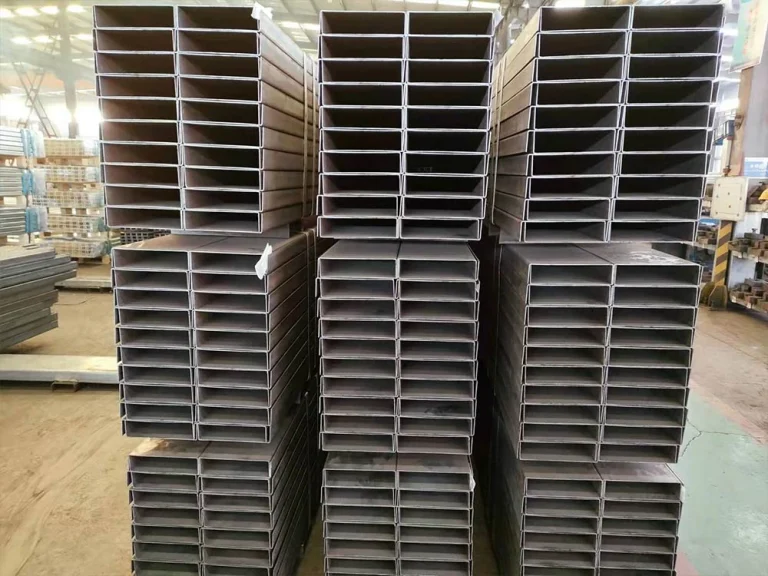
Tall buildings face strong twisting forces from the side. Our high-performance Viga de acero Omega meets these needs. Its unique Ω-shaped section boosts load capacity, stability, and twist resistance. The closed shape works better than open I-beams under dynamic strain. It cuts the risk of local buckling. This makes the Omega Steel Beam a solid choice for cantilevered roofs and modern seismic-resistant designs.
Seismic Piping Systems and Heavy-Duty Fasteners
Internal networks and industrial setups need stable yet adjustable supports. The Unistrut Channel provides a slotted framing system for modular builds. It comes in galvanized or stainless steel. The slots allow quick fixes and changes without extra drilling. High load capacity keeps conduits and racks in place during tremors. For roofing and secondary frames, the customizable Canal de acero C offers a light yet strong cold-formed option. It keeps weight down while holding good strength.
How to Vet a Reliable Supplier for Earthquake-Resistant Materials?
Ensuring Compliance with Global Seismic Standards (ASTM, EN)
Sourcing parts for seismic zones requires clear proof of origin and certifications. Buyers should ask for reports that show compliance with AWS, ISO, and EN rules. At CZT solar, we run strict checks at every step. These include dye penetrant tests, ultrasonic scans, and size checks. All custom parts meet ASTM, DIN, JIS, and GB standards.
Assessing Production Capacity and Export Reliability
Large projects need fast output and reliable shipping. We operate from Tianjin, a major northern China port. Our 28,000-square-meter plant supports 10GW annual capacity for support frames. The workshop has 25 automated lines and 15 punching lines. Monthly output reaches 5,000 tons with a thickness of up to 10mm. An international team handles custom orders to match local seismic needs and site conditions.
Preguntas frecuentes
Q: Why is stainless steel for earthquake resistance preferred over carbon steel in seismic zones?
A: Carbon steel often suffers fatigue and brittle cracks under repeated load reversals. Stainless steel for earthquake resistance offers better stretch and flexibility. It bends and deforms to handle seismic waves without sudden breaks.
Q: What are the best stainless steel grades for earthquake resistance in infrastructure projects?
A: Grade 2205 Duplex steel suits heavy civil work. Its two-phase mix gives double the yield strength of austenitic grades and strong protection against stress corrosion. For regular frames, Grade 316 and Grade 304 deliver high ductility where flexibility matters most.
Q: How does stainless steel for earthquake resistance improve the durability of mounting frameworks?
A: It stops twisting, loosening, or warping when ground motion hits fixed brackets. Corrosion-resistant parts keep full thickness and design values for decades. CZT solar builds these benefits into options like the Unistrut Channel and C Steel Channel to keep arrays steady during tremors.
Q: Which global testing standards certify stainless steel for earthquake resistance?
A: Seismic parts follow ASTM, EN, and ISO rules on tensile strength, stretch limits, and weld quality. They pass non-destructive checks such as dye penetrant and ultrasonic tests to meet current building code demands.
Q: How can global procurement managers identify a qualified manufacturer of stainless steel for earthquake resistance?
A: A good maker shows verified certifications and large-scale precision facilities. Look for providers like CZT solar that run multiple cold-forming and stamping lines. This ensures tight size control on big batches. An international team can also tailor profiles to the exact site seismic conditions.






 Spanish
  English
  Japanese
  Korean
  Arabic
  Russian
  French
  Thai
Thai