

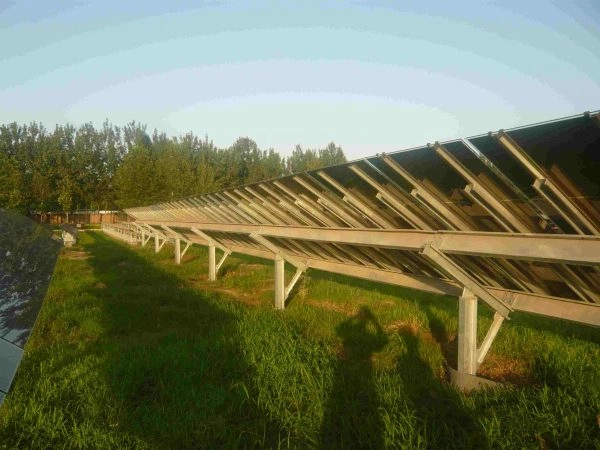
Snow changes the way a PV mounting structure behaves. In cold or high altitude regions, vertical loading can become a major structural constraint, especially when snow stays on modules for days or accumulates unevenly across long rows.
For engineers specifying ระบบติดตั้งพลังงานแสงอาทิตย์ for heavy snow loads, the structure has to be treated as a complete load path—from module frame to foundation. A strong beam is not enough if the connection or pile below it becomes the weak point.
Why Snow Load Matters in Solar Mounting System Design
Snow load is rarely uniform. Wind can push snow toward row edges, ice may remain after loose snow slides away, and adjacent tables can create local drifting.
Typical warning signs are purlin deflection, rail twisting, deformation around connections, or foundation movement. These may not cause immediate failure, but they reduce structural margin.
That is why snow load on solar panels belongs in the structural design stage, not in a maintenance discussion after installation.
1. Determine the Local Design Snow Load
The design starts with the project location.
Ground snow load, elevation, historical snowfall, snow density, exposure, and local codes all affect the design basis. Two sites at the same latitude can need very different structures if one is an exposed mountain site and the other is sheltered.
Ground snow load should not simply be copied onto the PV array. Tilt angle, mounting height, terrain, wind exposure, and drifting conditions can change the actual loading pattern.
Reliable site data matters. A generic value from a nearby city may be convenient during early design, but it can create risk later.
2. Consider Tilt Angle and Array Geometry
Tilt angle affects snow retention, but “steeper is better” is too simple.
A higher tilt can help snow slide off. It can also move snow toward the lower edge of the array or around the base. Low angle systems tend to retain snow longer, especially during extended freezing periods.
Row spacing, table length, module dimensions, and mounting height also affect accumulation. On long ground mounted arrays, uneven loading can be more critical than total snow depth.
Tilt should therefore be checked together with layout, wind conditions, and the overall PV mounting structure design.
3. Select a Mounting Structure with Sufficient Strength
Heavy snow projects often need more than a thicker standard rack.
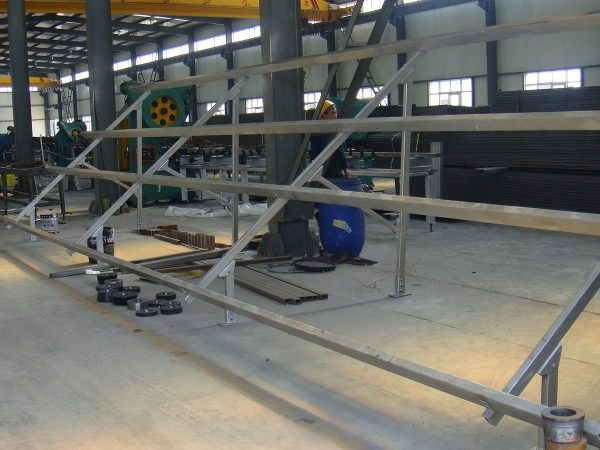
Posts, purlins, beams, rails, braces, bolts, and connections must work as one system. Engineers may increase profile thickness, reduce span, shorten post spacing, add bracing, or change section geometry.
There is usually more than one efficient solution. Reducing support spacing may control deflection better than adding steel everywhere. On another site, a stronger purlin may solve the issue without changing the pile layout.
CZT Solar can customize PV mounting structures according to snow load, wind load, module layout, and site conditions instead of relying on one fixed configuration.
4. Choose Materials Suitable for Snowy and Cold Environments
Structural strength is only part of the material decision.
Hot dip galvanized steel, Zn-Al-Mg coated steel, and aluminum alloy are all used in solar mounting systems. The better option depends on load, span, corrosion exposure, temperature variation, and service life.
Cold regions create repeated wet dry and freeze thaw cycles. Moisture can stay around joints and clamps. Where road salt or other chlorides are present, corrosion may become more aggressive.
For steel solar mounting structures, coating quality deserves close attention. A strong section with poor corrosion protection can become a maintenance problem well before the end of a 20 to 30 year PV project.
5. Do Not Ignore Foundation and Connection Design
Snow load travels through the entire structure:
Modules → rails or purlins → beams → posts → foundations.
Problems often appear at the transitions.
Driven piles may suit one site, while ground screws or concrete foundations work better elsewhere. In cold regions, frost depth and freeze thaw behavior matter because foundation movement can affect alignment and load distribution.
Connections deserve the same attention. Bolts, clamps, welded joints, brackets, and slotted holes should be checked against actual design loads.
An oversized beam does not make the system safe if the connection below it remains under designed.
6. Evaluate Snow Load Together with Wind Load
Heavy snow areas can also be high wind areas.
The same mounting system may face strong downward snow loading in one condition and uplift or lateral wind forces in another. Engineers should review dead load, snow load, wind load, and applicable load combinations rather than optimize for snow alone.
This can change post spacing, section size, bracing, connection details, and foundation requirements. A design that looks efficient under one load case may not work well across the full environmental load envelope.
How to Choose a Solar Mounting Supplier for Heavy Snow Projects
For heavy snow projects, supplier selection should go beyond unit price.
The supplier should be able to work with project specific snow loads, wind loads, module dimensions, array layout, soil conditions, foundation requirements, and local engineering standards.
Manufacturing capability matters too. Hole positions, tolerances, coating quality, and connection consistency affect how closely the installed structure matches the design. Pre-assembly can also help on cold weather sites where installation windows are short.
CZT Solar provides customized solar mounting systems and metal structural components for different project conditions, allowing the design to be adjusted to actual site loads rather than selected from a fixed catalog alone.
Conclusion
Heavy snow changes the structural priorities of a PV project.
Tilt angle, purlin span, post spacing, foundation behavior, connection strength, material protection, and wind interaction all deserve attention. The more reliable approach is to treat the mounting system as one continuous structure, not a group of separate parts.
Looking for a solar mounting solution for a high-snow-load PV project?
Contact CZT Solar to discuss your project location, module layout, snow load, wind load, soil conditions, and structural requirements. Our engineering team can help develop a customized solar mounting system for your project.
คำถามที่พบบ่อย
Q: What snow load should a solar mounting system be designed for?
It depends on project location, elevation, terrain, local code, array geometry, and snow conditions. Ground snow load should not be used directly without checking the applicable design method.
Q: Does a steeper solar panel angle reduce snow load?
It can help snow slide from the module surface, but drifting, refreezing, lower edge accumulation, and row geometry still need consideration.
Q: Is steel better than aluminum for heavy snow solar mounting systems?
Not always. Steel is common where higher structural capacity is needed, while aluminum offers lower weight and good corrosion resistance.
Q: Can a standard solar mounting system be used in a high snow region?
Yes, if the standard configuration passes the required structural calculations. Many heavy snow projects still need changes in member size, support spacing, bracing, or foundations.
Q: What information is needed to design a solar mounting system for heavy snow loads?
Typical inputs include project location, module size, layout, tilt angle, snow load, wind speed, terrain, soil conditions, foundation preference, and applicable standards.







 Thai
Thai  English
  Japanese
  Korean
  Spanish
  Arabic
  Russian
  French