

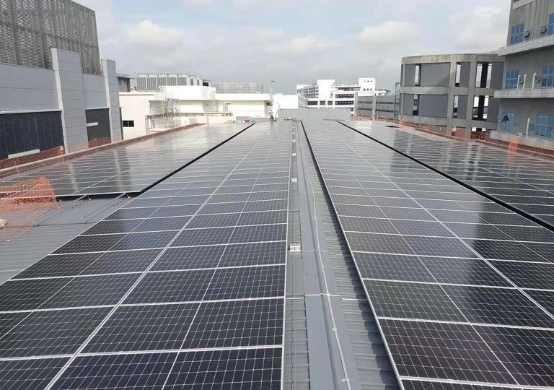
Commercial buildings frequently possess two unused spaces for solar energy: roofs and parking lots. Both areas can hold PV systems. However, their structural needs and business benefits vary.
Rooftop solar typically offers a financial edge. This is because the existing building acts as a solid base. A solar carport requires fresh foundations, upright columns, and sturdy beams. Yet, it delivers valuable shade. It also creates space for EV charging stations.
Ultimately, the ideal option relies entirely on the specific location.
Solar Carport vs. Rooftop Solar: A Quick Comparison
The primary distinctions remain highly practical.
| Factor | Solar Carport | Rooftop Solar |
| Space Used | Parking areas | Existing roof |
| Structural Requirements | Independent structure | Depends on roof |
| Installation Cost | Usually higher | Usually lower |
| Expansion Potential | Often high | Limited by roof area |
| Orientation | More flexible | Influenced by roof geometry |
| Added Value | Shade, EV charging | Uses idle roof space |
| Maintenance Access | Usually easier | Depends on roof access |
For a warehouse with a clear, structurally suitable roof, commercial rooftop solar is often the simpler option. For a mall, hospital or office campus with large parking areas, a commercial solar carport may create more value.
What Is a Commercial Solar Carport?
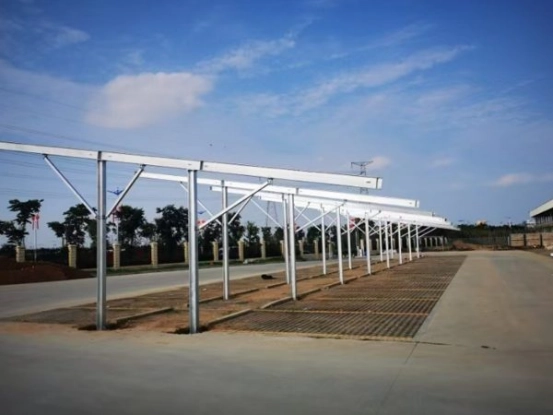
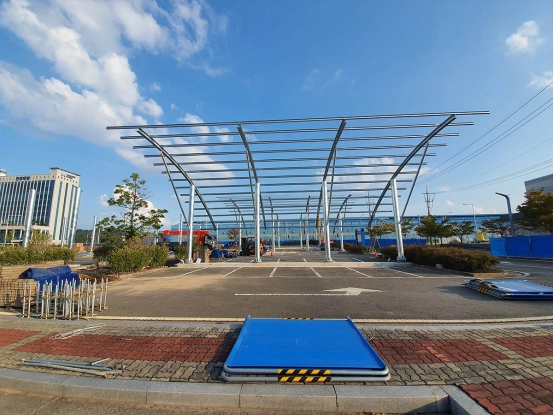
A commercial solar carport acts as a PV array. A protective canopy holds this array directly over parking spots. The solar modules rest securely on a steel or aluminum framework. This framework safely shifts heavy loads down through vertical columns. Finally, the weight reaches the deep foundations.
Specific details hold great importance here. The distance between columns directly impacts how cars move around. Furthermore, the required vehicle clearance dictates the proper beam height. Local wind forces, water drainage needs, and rust prevention methods also heavily shape the final steel design.
What Is Commercial Rooftop Solar?
Commercial rooftop solar relies on the actual building to serve as the main support platform. Warehouses, busy factories, and large distribution centers represent very common applications. These structures generally feature massive roofs.
Installers place the PV modules using a rooftop solar mounting system. Teams choose this specific system based on the exact roof style. They also consider the maximum safe weight limit and strict waterproofing requirements. However, rooftop obstacles exist. Bulky HVAC units, wide skylights, air vents, and required fire lanes frequently decrease the available space for solar modules.
Solar Carport vs. Rooftop Solar: 6 Key Differences
The choice becomes clearer when the actual project conditions are compared.
1. Available Space and System Capacity
Rooftop solar is limited by the building footprint and usable roof area.
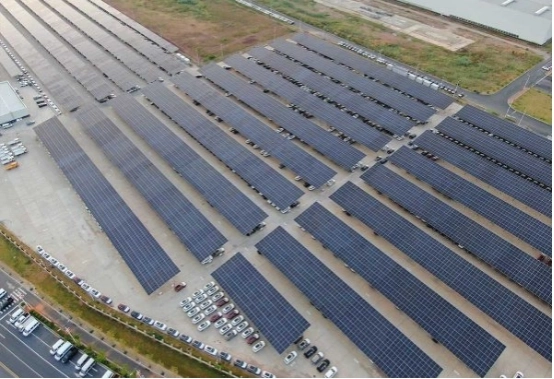
Carports use parking areas instead. On shopping centers, campuses and industrial parks, this can add substantial PV capacity without consuming new land.
Where both surfaces are available, a combined system may make more sense than forcing the project into one format.
2. Structural Requirements
Rooftop systems depend on the existing building. Roof condition, allowable loads and connection methods need to be checked before the mounting layout is fixed.
A carport is an independent solar mounting structure with foundations, columns, beams and module supports.
That gives designers more freedom, but wind uplift, span length and corrosion exposure need attention. On coastal sites, adequate strength is not enough if corrosion protection for solar mounting structures is poorly specified.
3. Installation Cost
Rooftop solar is usually less expensive structurally because the building already exists.
A solar carport requires foundations, fabricated steel, lifting equipment and more site work, so initial cost is normally higher.
Still, cost per watt can be misleading. If the structure also provides shaded parking or supports EV chargers, it is doing more than holding modules.
4. Solar Orientation and Energy Production
Rooftop orientation is often dictated by the building. Flat roofs allow more flexibility; pitched roofs allow less.
A solar carport design can usually be adjusted around the preferred tilt and orientation, though parking geometry and drive lanes still set limits.
Carports do not automatically generate more energy. They simply give the designer more freedom on some sites.
5. Additional Business Value
This is where carports become interesting.
A shopping center can improve customer parking. An office campus can integrate EV charging below the canopy. A hotel can turn an exposed parking area into a shaded asset while making its renewable energy investment visible.
Those benefits are difficult to capture in a basic system price comparison.
6. Maintenance and Accessibility
Carport modules are usually easier to reach than modules several stories above ground. Service work can therefore be simpler.
Rooftop maintenance depends heavily on building height, access routes and safety systems.
Carports have their own maintenance points. Drainage needs inspection, vehicles operate beneath the structure and exposed metal components should be checked periodically.
Which Option Is Better for Different Commercial Properties?
Massive warehouses and busy distribution centers serve as perfect candidates for rooftop solar. They just need strong, clear roofs. Meanwhile, solar carports frequently suit shopping malls, major hospitals, and university grounds much better.
They also work wonderfully for busy airports, modern hotels, and broad office campuses. This holds especially true if the parking zones are huge. It is also true if the owners plan to add EV charging stations.
Industrial parks remain completely flexible. They can easily choose either method. In numerous situations, blending rooftop solar alongside sturdy carports maximizes the true potential of the entire site.
How to Choose Between a Solar Carport and Rooftop Solar
Before selecting a commercial solar system, project owners should evaluate several key factors:
- Available rooftop and parking area
- Required solar capacity
- Roof condition and structural load capacity
- Local wind and snow loads
- Parking requirements
- Future EV charging plans
- Project budget
- Long term expansion goals
Buyers must pick the mounting structure based on actual site conditions. They must also look at structural weights, the planned module layout, and strict environmental rules. They should never base this choice on price alone.
Partnering with a highly experienced solar mounting system supplier helps immensely. This smart collaboration helps guarantee that the framework is perfectly designed for that unique commercial project.
How CZT Solar Supports Commercial Solar Projects
CZT Solar provides one stop PV mounting solutions for commercial and utility scale projects, including solar carport structures, rooftop mounting systems, fixed mounting systems, tracking systems, BIPV structures and customized metal components.
For commercial projects, coordination matters. Structural requirements, fabrication details and project specific components should work together. CZT Solar supports customized mounting solutions and metal structure manufacturing for different layouts and environmental conditions.
أسئلة متكررة
Q: Is a solar carport more expensive than rooftop solar?
Usually, yes. A carport needs foundations and an independent supporting structure. Rooftop solar uses the existing building. The difference becomes less important when shade, EV charging and other site benefits are included.
Q: Can solar carports generate more power than rooftop solar?
Not inherently. Output depends on available area, orientation, tilt, shading and module selection. Carports may offer more layout flexibility where roof geometry is restrictive.
Q: Are solar carports suitable for commercial properties?
Yes. They are especially suitable for shopping centers, offices, hospitals, factories and campuses with large parking areas.
Q: Can a commercial property use both rooftop solar and solar carports?
Yes. Large commercial sites often benefit from using both, especially when rooftop area alone cannot meet the target system capacity.
Conclusion — Solar Carport or Rooftop Solar?
Rooftop solar is difficult to beat when a commercial property has a large, structurally suitable roof. It is usually simpler and less expensive.
Solar carports become more attractive when parking space is abundant or the project needs shade, EV charging and greater design flexibility. On many commercial sites, the better question is not which system wins. It is how much value each available surface can produce.
Planning a commercial rooftop, parking area or combined PV installation?
Contact CZT Solar to discuss a mounting solution based on the actual project requirements.







 Arabic
  English
  Japanese
  Korean
  Spanish
  Russian
  French
  Thai
Thai